Nova is the perpetuals exchange reshaping market formation for Hyperliquid. Nova introduces Conviction Markets, the market formation primitive on the House of All Finance. Decide what lists next on Hyperliquid and earn from every market, forever.
There are 10x more capital markets that should exist onchain than actually do. The infrastructure to create them hasn’t been built. The first solver for capital origination is Nova.
Hyperliquid is where flows converge. Nova is where new flows enter.
The process of deciding which markets should exist, sizing them, sourcing their first liquidity, and assembling their first traders has historically sat inside exchange listing committees and bank structuring desks and has not been rebuilt for onchain finance. The rebuild to unbundle that work and run it as an efficient market process needs to happen with a new primitive for market formation.
Conviction Markets is that primitive.
Market demand is distributed. The people closest to latent demand are not exchange teams. They are domain experts, obsessive traders, niche communities, researchers, hedgers, people living inside the information flow before it becomes consensus. A commodities desk knows a venue should exist for a specific asset before any listing committee has discussed it. A macro analyst has been tracking an index for years and knows exactly who would trade a perpetual on it.
Conviction Markets gives these participants a direct economic path from identifying demand to originating a market and retaining a claim on what they helped create. A market is proposed and becomes immediately tradable. Real capital at risk reveals whether demand is real or theoretical. If the market proves sustained activity, it moves into a full orderbook inheriting the liquidity and trader base it already accumulated during formation.
Most exchanges acquire traders after a market is listed. By then, those traders may already have positions, habits, PnL history, and venue preference somewhere else. The exchange is competing for flow after the market already has a home.
Securitization did this to bank balance sheets. AMMs did this to market making. Conviction Markets do this to market formation.
The earliest moment to win a trader is the moment they first believe a market should exist. Conviction Markets captures traders at exactly that moment before there is an orderbook, before the market is widely known, before other venues are competing for the same flow. These traders have positions and history with the market from inception. They are not arriving later as mercenary flow. They are part of the market’s formation. Every Conviction Market is a trader acquisition funnel.
The next billion-dollar markets start here.
What is Conviction Markets?
Nova introduces Conviction Markets, the new primitive for market formation, where aligned incentives accelerate liquid listings by rewarding traders and LPs with lifetime fee sharing from all listed markets.
Conviction Markets is more than a better listing process. It is a market formation mechanism. Discovery, validation, liquidity formation, trader capture, and economic alignment are all the product of one system.
Markets can be proposed, traded, and capitalized before they move to an orderbook on Hyperliquid.
Participants earn direct fee sharing from all listed markets on Nova, and when a market shows sustained activity it graduates from Nova directly to Hyperliquid, bringing its liquidity, traders, and Conviction Token with it.
The creator, early traders, and liquidity providers earn revenue share from every trade for as long as the market exists. They become equity-like participants in the market rather than early users who get replaced once volume arrives. This is not an incentive program with an expiry date. It is a structural alignment between the people who originated the market and its ongoing economics. Revenue share makes them permanent.
How Conviction Markets work
Participants receive Conviction Tokens for each new listed market: the ERC-20 token that rewards holders with a lifetime share of the market’s fees.
Participate by backing a market in the Conviction Drop: every 3 days spend Conviction Points backing the market you want to see listed next and receive Conviction Tokens of the listed market. Back the winning market to receive a boosted share of its Conviction Tokens.
Earn Conviction Points by trading and by providing liquidity to the Conviction Pool.
Propose a market to be backed in the Conviction Drop and receive 10% of its Conviction Tokens if it gets listed.
When a market shows sustained activity it graduates from Nova directly to Hyperliquid, and it brings its Conviction Tokens and traders with it.
Conviction Markets is whitelisted at launch. More information on Telegram.
Quick Start
Earn Conviction Points and use them to earn direct fee sharing from all of Nova’s markets and decide what lists next.
What you need
An EVM wallet.
Your X account.
USDC, from any chain you hold it on.
1. Connect
Connect your wallet, and connect your X account to appear on the leaderboard. Conviction Markets is whitelisted at launch. Follow how to get your whitelist on X.
2. Deposit
Click Deposit and send USDC from any chain you hold it on. Minimum 5 USDC, flat 0.20 USDC fee, and it lands in your trading balance in seconds. See Deposits and transfers.
3. Earn Conviction Points by trading or providing liquidity
Pick a market, Hyperliquid perps or Nova markets and start trading. You earn Conviction Points from your first trade. Providing liquidity to the Conviction Pool earns them too, continuously.
Every 3 days, three candidate markets stand for listing. Spend points on the one you believe in. Skipping is free, and an unspent balance only grows. At the Drop, everyone who backed receives the new market's Conviction Token: a lifetime share of its fees.
Trade any market on Nova’s Trading Terminal and earn Conviction Points.
Nova’s Trading Terminal
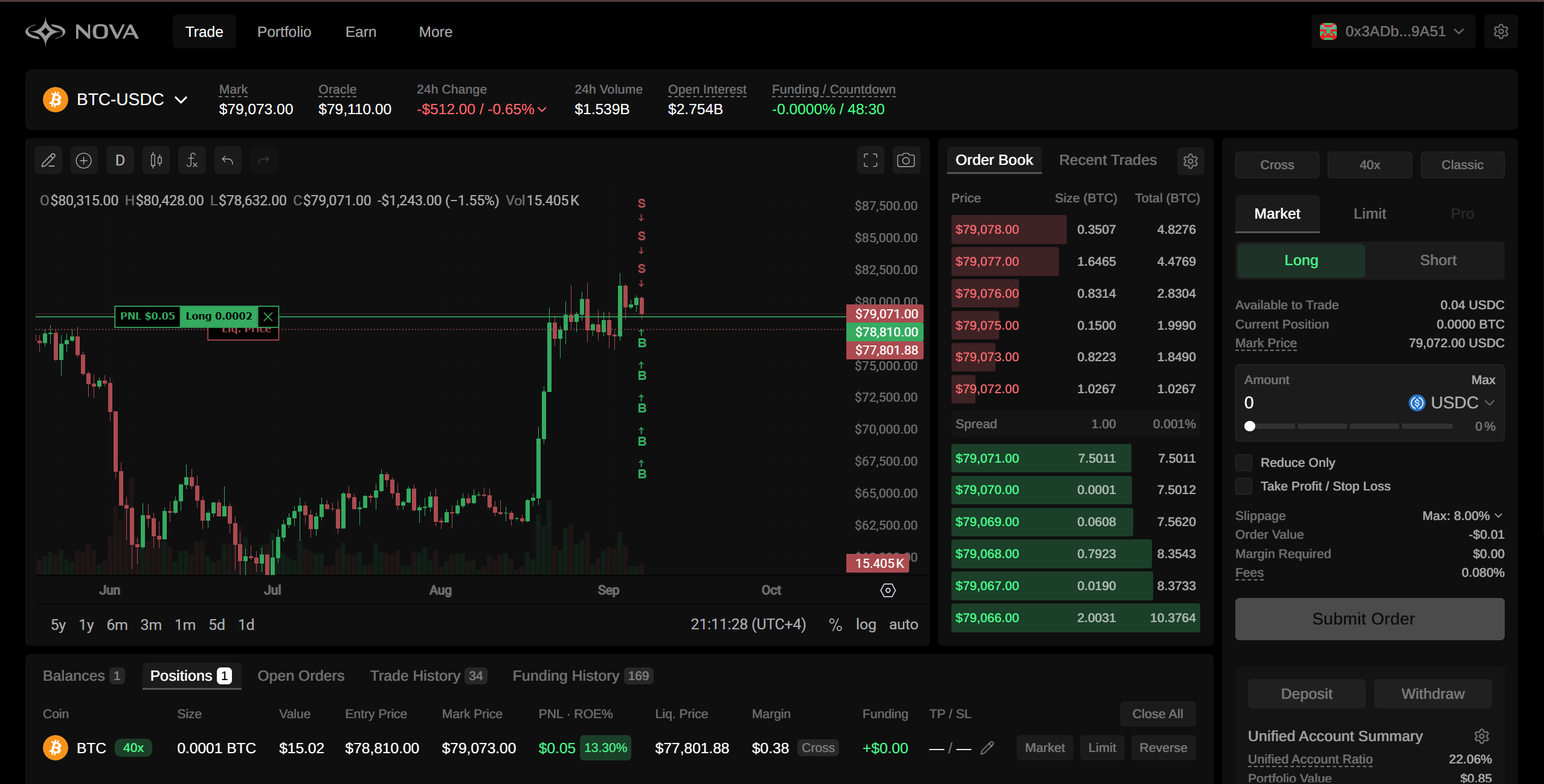
The trade panel
Pick a side, set the size, confirm. Leverage and margin mode sit at the top of the panel.
Market fills immediately at the best price available, and never worse than the slippage cap you set. Limit rests at the price you name and fills only there, or not at all.
Take profit and stop loss are exits. Tick the box and set both prices while you place the entry, and they are attached to it. Or place them later from the same trade panel, against a position you already hold: each one becomes its own order, listed under Open Orders, where you can see it and cancel it.
Reduce only keeps an order from ever opening more than you have. It can shrink a position or close it, never flip it.
Field
What it does
Market / Limit
Market fills now. Limit rests on the book at your price
Long / Short
Long profits when the price rises, short when it falls
Amount
Size. Type it, or use the slider
Reduce only
The order can only shrink a position
Take profit / Stop loss
Sets your exits, with the entry or later on their own
Slippage
Market orders only. The worst price you accept
Order Value is the notional, Margin Required is what it locks, Fees is what it costs.
A position is editable after it opens: add or remove collateral, adjust leverage, close part of it. Each edit re-checks the liquidation price before it applies.
Trade Panel
Choosing a market to trade
On Nova’s Trading Terminal, you can trade both Hyperliquid’s and Nova’s markets.
Hyperliquid perps
Nova markets
What it is
Markets that are listed on Hyperliquid
Markets that are listed on Nova
Counterparty
The Hyperliquid order book
The Conviction Pool
Settles on
Your Hyperliquid balance
Your Nova balance
Both sit behind one interface and one trade panel. Switch with the market selector.
Examples
You want to
Do this
Go long 250 USDC of BTC now
Market, Long, 250, Place Order
Buy only at 78,000
Limit, Long, price 78,000, size, Place Order
Set a target and a stop
Tick Take profit / Stop loss, set both prices
Close now
Close on the position row
Close part of it
Opposite order, smaller size, Reduce only ticked
Your position
The row shows size, entry price, mark price, PnL, margin, and the liquidation price. Adding margin pushes the liquidation price away, removing it brings it closer.
Liquidation triggers on the mark price, an oracle price rather than the last trade.
On Nova markets
Same trade panel. Your counterparty is the Conviction Pool, so a large order moves your own execution price, shown before you confirm. The opening fee is set when you open, the closing fee when you close, and holding fees accrue while you hold.
Fees are calculated on the position's notional: collateral times leverage. Each trade pays an opening fee when it opens and a closing fee when it closes. Both use the same rate, set per market by asset class, and both are charged on notional, not on collateral and not on PnL.
Asset class
Opening
Closing
Crypto
3.5 to 6 bps
3.5 to 6 bps
Stocks, indices and commodities
3 to 5 bps
3 to 5 bps
Forex
1.2 bps
1.2 bps
Open plus close is twice the one-side fee. Trading fees (opening and closing) are what the market's Conviction Token holders are paid from.
Spread and price impact, applied to the oracle price at execution (below).
Holding fees while the position is open: a borrowing fee to the pool, and funding between traders (below).
Everything that applies is in the trade panel before you confirm.
Spread and price impact
Your execution price is the oracle price adjusted by two things. A small fixed spread, set per market: smaller, less liquid underlyings carry a wider one. And a dynamic price impact that scales with your size against the underlying's real depth, and with the market's open-interest skew: a trade that makes the imbalance worse pays more, and a trade that reduces it pays less, and it can even execute better than the oracle price. This is what an order book's depth does elsewhere, done explicitly: size and direction pay their real cost, and the book stays balanced without shrinking the caps.
Holding fees
Two components accrue while a position is open, both visible on the position row.
Borrowing fee, paid to the Conviction Pool. It scales with how much of the pool's capacity your side of the market is using: a crowded side pays more per hour than a quiet one. This is the pool's compensation for backing your leverage.
Funding fee, paid between traders: the crowded side pays the light side, and Nova takes none of it. It is the one fee that can work in your favour: hold the light side of a skewed market and funding pays you.
Rates and countdowns are in the market header; on your position both are folded into PnL.
Liquidations
Every position shows its liquidation price before you open it. It sits where your losses, fees included, reach 90% of your collateral, deliberately short of 100%, so the position is always closed while there is still margin to close it with. Cross it and the position is liquidated: the remaining collateral, minus the liquidation fee, is gone to the pool.
The shape of it, at any leverage: at 10×, a roughly 9% move against you liquidates; at 50×, a fifth of that. Leverage moves the liquidation price closer, never the rule. Liquidations are executed automatically the moment the oracle price crosses the trigger, run by Nova at launch. Your take profit and stop loss, if set, always fire first when their prices come first.
Deposit on the Conviction Pool and earn direct fee share from all Nova’s Markets and earn Conviction Points.
What is the Conviction Pool?
The Conviction Pool is the pool that exists to provide liquidity for every Nova market launched in Conviction Markets. You deposit USDC; each newly listed market plugs straight into it, and markets can quickly grow in Open Interest.
What it collects
15% of all trading fees from Nova markets (opening and closing).
Borrowing fees from every open position, for as long as it stays open.
Liquidation proceeds when a position is liquidated.
Trader losses.
Conviction Points, on the capital you leave in.
The other side of it: when traders close in profit, the pool pays them.
How pool capital accrues
Capital in the Conviction Pool earns points continuously through a reward index, from the moment it is deposited until the withdrawal is claimed; capital waiting out the withdrawal delay still counts. Only capital in the pool earns; nothing accrues to funds that have left.
Epochs
Deposits are instant. Withdrawals are requests that settle after a delay counted in epochs, then you claim.
Action
Settles
Deposit
Instantly, at the current share price
Withdrawal
After the withdrawal delay, counted in epochs, then claim your USDC
Cancel
Immediately, while still pending
The epoch, the time left in it and the delay are shown before you confirm.
Conviction Markets is the new primitive for market formation. You earn Conviction Points, spend them on the proposed markets you believe in, and receive Conviction Tokens, a lifetime share of each listed market's fees, at the Drop.
Backing a market at the Drop
A Conviction Drop is one listing event: the backing, the launch of the winning market, and the distribution of its Conviction Token. One every 3 days. Each Drop has 3 proposed markets that you can back, shortlisted by the Nova team from the community proposals. The candidate with the most points spent on it wins.
Back a market at any moment while the Drop is open.
Once you back a market the points are spent and backing a market is permanent.
If you back a market, you spend at least 25% of your balance. Split it across one, two or all three candidates, as you like.
Adding more is always allowed. Withdrawing is not: spent points stay spent.
You keep accumulating points while the Drop is open. A 100% toggle sends everything you hold at the moment plus everything you keep earning until the close of the Drop.
Skipping is free and unlimited. You keep earning while you sit out.
While a Drop is open, nothing that shows who backed what is published: no names, no amounts, no running totals, only who is taking part. At the Drop the winner lists, the tokens go out to everyone who backed any of the 3 markets, and the full Drop becomes public, permanently. Backing the winner market gives you a boost in received Conviction Tokens.
Losing candidates are not gone. They stay, and they can run again.
Proposing a market
Anyone can propose, and it costs nothing: a ticker, why it should exist, a link to its price, and a payout address. If it lists, the proposer receives a 10% share of its Conviction Tokens.
Earned by trading and by providing liquidity to the Conviction Pool, and yours until you use them. Spend on Conviction Drops and receive Conviction Tokens.
What they are
Conviction Points are the balance you back markets with. Every Conviction Drop is decided by them, and every Drop's token distribution is computed from them. While a Drop is open, Conviction Points continue being accrued.
How you earn Conviction Points
Trade Nova’s markets or on Hyperliquid through Nova’s Trading Terminal. Every trade earns, start trading at app.nova.markets.
Referrals. A share of what the people you bring in earn. It costs them nothing, and everyone earns extra.
Referrals
Attribution is explicit and permanent: once an account registers your code, a share of its base activity accrues to you: 10% to you, 5% extra to them. One level deep. No recursion, and no retroactivity: activity before registration counts for no one.
Spend, or stack
Backing spends points. Skipping is free and unlimited, and you keep earning while you sit out, so a balance started on day one, left alone, walks into a later Drop big enough to decide it. Being early is never wasted: your balance compounds until you choose to use it.
Spending and receiving Conviction Tokens
You spend points at Conviction Drops to receive Conviction Tokens. If you back a market, you spend at least 25% of your balance. The full rules of backing live in Conviction Drops.
Rates
Set by Nova, adjusted between Drops, and frozen for each Drop when it opens. What applies today is in the app. Changes are never retroactive.
List your market on Hyperliquid and earn a 10% revenue share, forever.
Name a ticker while a listing is open for suggestions. If yours lists, you receive 10% of its Conviction Tokens.
Referrals
Refer users and earn direct fee sharing from their trades and boosted Conviction Points.
Sign-up using a referral and receive a 5% boost on all your earned Conviction Points.
Refer a user and receive 10% of all their earned Conviction Points.
Check your referrals on the Conviction Markets page.
Conviction Tokens
The token that gives holders a lifetime share of each market’s fees. Every listed market has one.
Getting Conviction Tokens
Back a market in the Conviction Drop. Everyone who backs receives, pro rata and the winner's backers get a boosted share.
Propose a market that is listed on a Conviction Drop.
Buy in the open market.
A Conviction Token pays 85% of its market's trading fees pro rata to its holders. Trading fees are the opening fee and the closing fee. What that is worth depends on how much the market trades, the larger the volume the more it is worth.
Claiming your accrued fees
Fees accrue in USDC and stay there until you claim. Claim your share at any time.
Trading Conviction Tokens
Conviction Tokens are ERC-20 tokens and can be transferred or traded. The app points you to the marketplace where each token's liquidity lives. Selling passes future fees to the buyer; what has already accrued stays yours.
Every keyword in these docs, one line each. When a page uses a term, this is what it means.
Conviction Markets
Conviction Markets
The new primitive for market formation: decides what Nova lists next
Conviction Drop
One listing event: the backing, the launch of the winning market, and the distribution of its Conviction Token. "The Drop" for short
Conviction Points
Your balance. Earned by trading and by providing liquidity to the Conviction Pool; spent on Conviction Drops
Backers
Everyone who spent points in a Drop. The winner's backers are those who spent on the market that listed; they get a boosted share
Conviction Token
The token that gives holders a lifetime share of its fees. One per listed market; pays 85% of its market's trading fees (opening and closing) pro rata to its holders
Candidate
One of the 3 proposed markets you can back in a Drop, shortlisted by the Nova team from community proposals. Losers stay, and can run again
Sealed
While a Drop is open, nothing that shows who backed what is published. At the Drop, the full Drop becomes public, permanently
Trading
Nova market
A market listed from a Conviction Drop, trading against the Conviction Pool at the oracle price
Conviction Pool
The one pool behind every Nova market: the counterparty to every trade, funded by depositors
Opening fee
The per-market fee to open a position, charged on notional. Together with the closing fee, this is the trading fee Conviction Tokens pay from
Closing fee
The same rate as the opening fee, charged on notional when the position closes. Open plus close is twice the one-side fee
Spread & price impact
Adjustments to the oracle price at execution: a fixed per-market spread, plus dynamic impact from your size and the market's skew
Holding fees
The two costs of keeping a position open: the borrowing fee (paid to the pool) and the funding fee (paid between longs and shorts; it can pay you)
Lists / graduates
A market lists on Nova when it wins its Drop; it graduates from Nova directly to Hyperliquid when it shows sustained activity
Liquidation price
Shown before you open: where losses, fees included, close the position automatically
Epoch
The Conviction Pool's clock: open PnL is marked on epoch boundaries, and withdrawals settle on them
Pricing and oracles
How the Pricing and Oracle feeds for Nova’s markets work.
Oracle-priced, not book-priced
Nova’s markets are pool based perpetuals. Every trade executes against the Conviction Pool at the oracle price of the underlying, adjusted for price impact, plus the market’s opening fee.
The feed
Prices arrive as signed reports of bid, mid and ask, aggregated across the underlying's real markets, so no single venue's print is ever the price. The reason is leverage: at 10×, a wick of a tenth of a percent on one exchange is a 1% error in your PnL. An aggregated median cannot be wicked by one thin book, which protects both your liquidation price and the pool that takes the other side.
Fresh at execution
You sign an order; execution happens onchain with a price report fetched for that execution and verified in the same transaction that settles the trade. There is no stale price to trade against: a report that fails verification reverts the trade rather than filling it.
Spread and price impact
Execution adjusts the oracle price twice. A small fixed spread per market covers the underlying's baseline liquidity, wider for smaller markets. A dynamic impact then scales with your size against the underlying's real depth and with the market's open-interest skew: worsen the imbalance and you pay more, reduce it and you pay less, sometimes better than oracle. This is the work an order book's depth does elsewhere, done explicitly: size pays its real cost, and nobody leans on the pool with unlimited size at a flat price.
Nothing to push
The defences stack. The price is an aggregated median, so moving it means moving the underlying's actual markets against their full depth. The impact curve makes one-sided size expensive, so a manipulator pays their way in and out. And each market carries exposure bounds, so whatever edge remains cannot be scaled into a number that matters.
Markets that close
A market follows its underlying's clock. Crypto trades 24/7; a stock or an index trades when its price does, and pauses when the underlying's market closes. The app shows each market's hours before you open a position.
One Conviction Pool behind every market: what that means precisely, and why deposits move on epochs.
The counterparty
Every position on every Nova market has the same other side: the Conviction Pool. When a trader closes in profit, the pool pays the difference; when a trader closes at a loss or is liquidated, the pool keeps it. There is no peer on the other end of your trade, and no borrowed asset: the leverage is synthetic, backed by the pool.
What it collects, what it pays
Into the pool: borrowing fees from every open position, for as long as it stays open; liquidation proceeds; and trader losses. Out of the pool: trader profits. Two flows deliberately pass it by: opening fees belong to the holders of the market's Conviction Token, a lifetime share of its fees, and funding is paid between longs and shorts to keep each market's book balanced; it can even work in a trader's favour, and the pool never touches it. Depositors also earn Conviction Points continuously while their capital is at work.
The share price tells the truth
A share's price is simple arithmetic: what was deposited, plus every fee the pool has earned, minus the traders' net profit against it, including the unrealised profit and loss of positions still open, snapshotted at each epoch. You enter and exit at a price that already reflects the pool's exposure: there is no way to deposit just ahead of good news, or leave just ahead of bad, at a stale number.
Why epochs
Pool capital is live: it is the counterparty to positions whose value moves every second. Open PnL is snapshotted at epoch boundaries, and that settled mark is the only price shares move at: a deposit enters instantly at that mark, and withdrawals are requests that settle on a boundary, then you claim. This is what makes the pool fair to sit in: nobody trades its shares against a swing the mark has not settled yet. A deposit starts backing trades, and earning, from the epoch it enters.
Leaving
A withdrawal is requested, waits its delay counted in epochs, then is claimed in its window. The delay exists because your capital is backing open positions and has to be released, and it scales with the pool's health: the better collateralised the pool, the shorter the wait (1 to 3 epochs; an epoch is 3 days). Your shares keep earning fees for the whole lock. Cancel a pending request and the capital goes straight back to work.
Can the pool fail to pay a winner?
The exposure is bounded on purpose. Each market carries open-interest caps sized against the pool, so the sum of what traders could win is limited relative to what the pool holds: a hot streak draws the share price down, it does not leave a winner unpaid. Above full backing, the pool builds a buffer: fees accumulating past 100% collateralisation sit as a cushion between traders and depositors before any drawdown touches deposits. The caps, the buffer target and the numbers are published at launch.
One pool, every market
A newly listed market plugs into the pool and trades with full depth from its first minute: no market raises its own liquidity, and no market trades against a thin, drainable pot of its own. Each market is capped in how much of the pool's capacity it may use, so no single market can monopolise the depth or the risk. The other side of the coin, said plainly: the pool's exposure spans the whole board. Depth is shared, and so is risk: one market's bad day is diluted across every market's fees.
What fills in at launch
The pool's risk parameters, the open-interest caps and the buffer target will be published here at launch, with the numbers.
There are 10x more capital markets that should exist onchain than actually do. Deciding which markets exist has always been committee work; Nova turns it into a market process that measures demand with real capital and lists what wins. Conviction Markets is the new primitive for market formation.
What do I need?
An EVM wallet and USDC. Minimum deposit 5 USDC, flat 0.20 USDC fee. Your X account gets you the leaderboard and the whitelist.
Is Nova a different exchange from Hyperliquid?
Yes, they are two different exchanges. You trade both on Nova's Trading Terminal, and both count towards Conviction Points. Markets on Nova that see great volumes graduate to Hyperliquid and take their Conviction Tokens and traders with them.
Why trade here rather than on Hyperliquid?
Your volume works twice. Execution is the same, but every trade on Nova earns Conviction Points, points decide what lists next, and backing a listing pays a lifetime share of its fees. On Hyperliquid alone your volume is just volume; on Nova it compounds.
No margin, but my balance is not empty.
Your funds are in spot rather than perps, or on the other venue. See Deposits and transfers.
Costs
What does Nova add on Hyperliquid fees?
A builder code of 3.5 bps. The rest is Hyperliquid's own fee.
What does a Nova market cost, all in?
An opening fee and a closing fee, the same rate, set per market by asset class: 3.5 to 6 bps for crypto, 3 to 5 bps for stocks, indices and commodities, 1.2 bps for forex. Spread and price impact on the execution price, and holding fees while the position is open: a borrowing fee to the pool, and funding between traders, which can also pay you. Every number is in the trade panel before you confirm.
Can I edit a position after opening it?
Yes: add or remove collateral, adjust leverage, or close part of it. Take profit and stop loss can be attached at entry or added later.
What happens during a liquidation?
Every position shows its liquidation price up front. If the oracle price crosses it, the position is closed automatically and the remaining collateral, minus the liquidation fee, goes to the pool. Your take profit and stop loss fire first if their prices come first. See Fees and funding.
Do I pay funding to Nova?
No, funding is paid between traders.
Conviction Points
How do I earn them?
By trading Nova’s markets or Hyperliquid through Nova’s Trading Terminal, by depositing in the Conviction Pool, and through referrals: 10% of what your referrals earn comes to you, and they earn 5% extra.
What are the rates?
Set by Nova and adjusted regularly. What applies today is in the app.
Conviction Markets
Can I see how the Drop is going?
No, and neither can anyone else, until the Drop.
What if my market does not win?
You still receive the new market's Conviction Token, pro rata. The winner's backers get a boosted share; skipping the Drop receives nothing. And your candidate is not gone: losers stay, and can run again.
Can I change my backing?
You can always add more, to the same candidate or another, and you can split across the slate. You cannot withdraw points already spent.
What does proposing cost?
Nothing. If it lists, the proposer receives a 10% share of its Conviction Tokens.
Earn
Which one do I use?
The Conviction Pool is the counterparty to Nova's markets, and it is the one that earns Conviction Points. The NLP Vault does market making on markets listed on Hyperliquid.
How fast can I get out?
Getting in is instant; getting out is not. Pool withdrawals wait 1 to 3 epochs, 3 to 9 days depending on the pool's health; the vault takes up to 7 days.
Risks and disclaimers
Trading
Leverage. A position at maximum leverage is liquidated by a small move.
Oracle prices. Liquidation runs on a mark price from an oracle.
Size. On Nova markets a large order moves your own execution price.
Gaps. A stop does not protect against a gap.
Earn products
You are the counterparty. Trader profits come out of your deposit.
Exit is not instant. Epochs on the pool, up to 7 days on the vault.
Hyperliquid. Matching, settlement and balances depend on it.
Operated components. Keepers relay orders and oracles are run. Nova is centralised today.
Disclaimers
Not financial advice. Nothing here is financial, investment or trading advice.
Risk of loss. Leverage can cost you your entire capital. Deposits are at risk. Any yield figure shown anywhere is an illustration, never a guarantee.
Conviction Points. An accounting entry. No ownership, no claim, rates adjusted, and no promise of a token or an airdrop. A Conviction Token pays only what its market generates, which can be zero.
Regulatory. You are responsible for determining whether your use of the protocol complies with the laws that apply to you.
No guarantees. Nova may modify any aspect of the protocol, including fees, points rates and listings.